HIDING IN PLAIN SIGHT - PENTRE IFAN
HIDING IN PLAIN SIGHT - PENTRE IFAN
JUNE 5, 2026
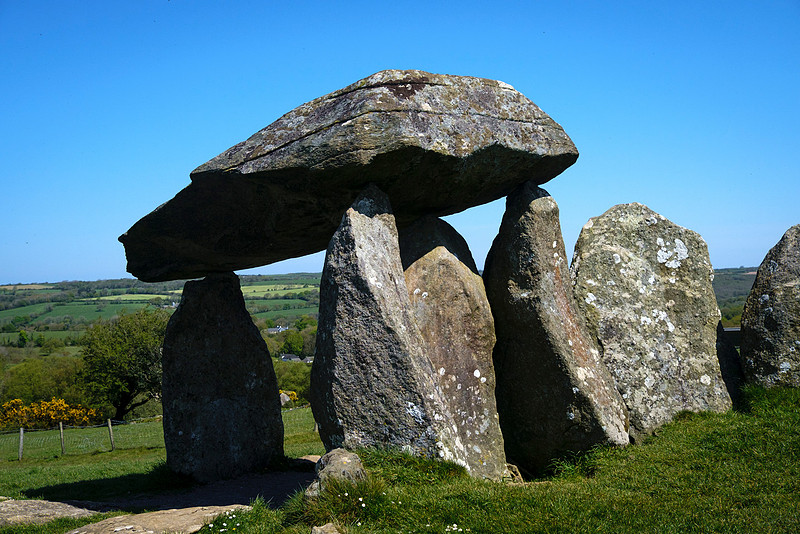
 PENTRE IFAN
This week I’d like to show you one of the most mysterious ancient monuments in the British Isles. Fran and I had the opportunity to visit the site as the first stop on our long drive from Pembrokeshire to Snowdonia after a week on the coast. I tried to find a few places to stop and break up the drive of more than three hours - about as far as you can drive in Wales, which is about the size of New Jersey, with a lot of sheep and only three million people.
This was our first stop, only about a half hour from our cottage. By this time I had planed that the usual obscure route would take about twice as long as I anticipated. I was very surprised that while the road was single-track for the most part, it was clearly marked and a straight forward route south into the hills. There was little traffic since we were arriving just at opening time, which confused me since this was clearly an outdoor site in the middle of nowhere. I guess the site was closed at night to cut down on Druid sacrifices.
Pentre Ifan was described as an ancient burial chamber, which also confused me since it was clearly out in the open on a typical Welsh hilltop. We found the carpark and proceeded down what was a delightfully short stroll on the border of several fields of sheep and cattle, through a gate, past a single sign to confront a series of stones that had stood there for about five thousand years, as near as anyone can tell.
Pentre Ifan is famous for being one of the few ancient monuments that showed off an audacious structural feat. Three standing stones, along with a few more nearby stone buddies. somehow hold up an even larger stone on three points above your head. The only thing that keeps the faith that it will not come crashing down on your head is that it has not fallen for five thousand years before you showed up today. I’m not the luckiest person, but those are pretty good odds that you will survive the visit.
There were a few families at the site, including a few that were conducting picnics on several of the tipped-over stones in lieu of any picnic tables. One gentleman noisily flew his drone over our heads until he was confronted by another visitor who pointed pointed out the very large sign banning drones from the site.
The biggest mystery for me was how this was described as a burial chamber, when it was clearly open for anyone energetic enough to climb the hill. That is what clearly sets these ancient monuments apart from the merely old castles and churches that dot the landscape. No matter how old the surrounding stone walls dividing the fields over the centuries, and the Oak trees that look like they might predate the American Revolution, nothing we see today has anything to do with the original site of the standing stones. Twenty five generations of 200 year-old Oak trees have lived and died and disappeared since the monument was erected.
The mystery of Pentre Ifan is that for probably the first few thousand years of it’s existence it was buried far underground under a hill of dirt. It was accessible only through a series of tunnels, and used for the burial of local chieftains lost to pre-history. Wrapping my head around the idea that these stones only appeared to modern men because the hill washed away to reveal their presence thousands of years later only increased the mystery of the site.
Welsh time creeps up on you in funny ways. Having lunch in a five hundred-year old pub that hasn’t really changed since people got there on horseback instead of a rental car has a way of elevating the experience. Walking among standing stones in a field nearby only heightens the feeling that we only get a very brief time on Earth. I hope you have enjoyed this brief trip back five thousand years in rural Wales.
