A RIVER IN THE SKY
A RIVER IN THE SKY
JULY 17, 2026
 A RIVER IN THE SKY
This week I would like to describe our brief visit to a unique site in North Wales. On our journey out of Snowdonia, Fran and I stopped at the town of Llangollen, whose claim to fame is the site of a masterpiece of Nineteenth Century engineering, the Pontcysyllte Aqueduct over the Llangollen Valley and the river Dee. It is a Unesco World Heritage Site.
For a very brief period before the dawn of the Age of Railroads, water transport was the most efficient and cheapest way to ship items, especially heavy items, around Great Britain. Engineers began to create rivers out of whole cloth to connect Britain’s industrial centers. This canal network soon linked most of the sites of the first industrial revolution, but geography through some real obstacles in the way of expansion. Canal locks could overcome moderate slopes, but real valleys presented an obstacle to a system that depended on gravity’s forbearance to allow for transportation on to the flatland.
The solution, albeit an audacious one, was to look back to the Roman engineers of the ancient aqueducts that brought water to Rome. The new waterways would not conform to geography but bridge it. These new aqueducts would not be used to transport water, but would use water to move goods along straight paths that ignored shifting terrain. The canals would now continue in the air when the ground had fallen away, until it reached the other side of the valley.
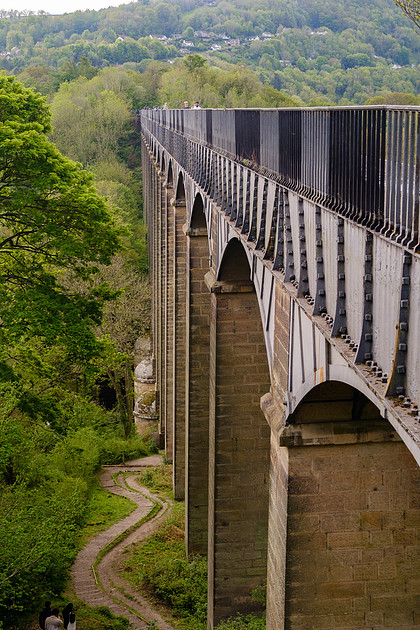
Pontcysyllte Aqueduct, finished in 1805, spans nearly one thousand feet across the valley, providing a level path which reaches more than127 feet above the valley floor. A waterway that can accomodate narrow canal boats is accompanied by a narrow footpath that allowed for horses to help drag the boats along. While there is nothing to prevent a maritime mishap that would ruin someone’s life along the canal, at least a stout fence protects the chasm side of the towpath. There is no protection for a pedestrian who manages to waver on the other side of the path into the canal itself.
Thomas Telford, who later built some of the world’s first suspension bridges nearby, was responsible for this leap into the unknown. Originally very successful in moving most of the slate and iron ore from the isolated valley to the “Satanic Mills” of Northern England, the Aqueduct has been preserved as an example of Georgian engineering that can still illicit gasps in the TwentyFirst Century. It is the longest aqueduct in Great Britain and the highest aqueduct in the entire world.
As usual in Wales the most difficult and dangerous part of our visit was finding and negotiating the car park. The official maps were clearly wrong, and even the satellite navigation was not up to actually finding the car park. We circled the area three times, and it was only my obstinate nature that allowed us to eventually find our way.
Most photographs, including the one I’ve shown here, present the site as a pristine journey through across the valley with your honey on your side. Reality forced me to admonish Fran that no matter what happened, she should not let go that rail. Hundreds of tourists ran across the path, seemingly blind to the fact that they were only scant inches from plunging into the canal. When we encountered other people who stood white-gripped on the rail, seemingly unable to either keep moving or go back, one had to go hand over hand around them. It was awfully hard not to decry the ravages of tourism while being a tourist, but the experience was still not to be missed.
