ST. PAUL'S STRAIGHT-ON
ST. PAUL'S STRAIGHT-ON
SEPTEMBER 4, 2026
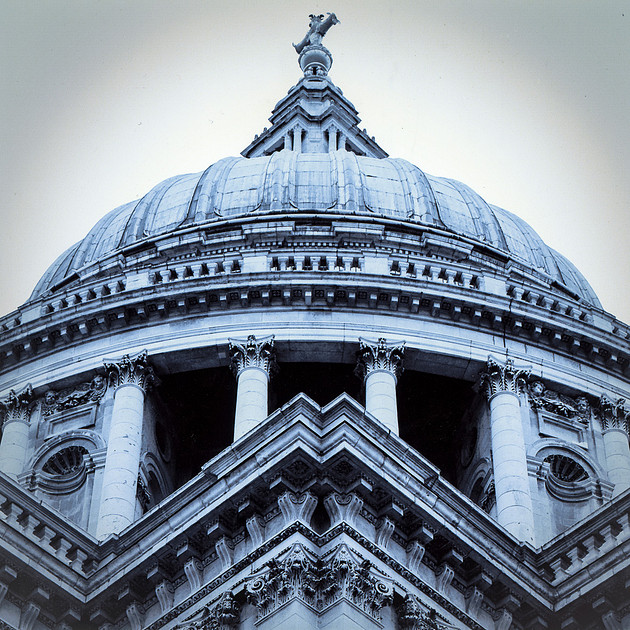

A FORCED SYMMETRICAL VIEW OF THE DOME
This week I would like to return to London to take a look at a detailed view of St. Paul's Cathedral which is included in my latest book, “Urban Fragments.” I created this image during a trip to London with Fran and Benjamin in 2008. Like most of our trips to the United Kingdom, we had a wonderful time “on holiday” while the world economy took yet another dive.
St. Paul’s is Sir Christopher Wren’s masterpiece, the crowning achievement of his career which included rebuilding of most of London’s historic church buildings. An architect’s career is a combination of artistic genius, political and economic patronage, and shear luck. One of the most important cities in the entire world managed to almost completely burn down in “The Great Fire” of 1666, which afforded Wren and others the chance to rebuild it in a new Classical style to replace the Medieval Gothic that characterized the city before the catastrophe. The Cathedral we know today was finally finished in 1710.
St. Paul’s is Wren’s attempt to crown London with a church that could compete with St. Peters in Rome. It also would assert the importance of the City of London as compared to the Royal precincts of Westminster Abbey to the west. One of the ironies of London is that the separation of church and state is represented by two cathedrals. St. Pauls, modeled on a Renaissance Rome that predates it by two hundred years, was built two hundred years before the completion of the new parliament in Westminster that completed the Gothic assemblage centered on Westminster Abbey. The survival of St. Paul’s during the Blitz became one of the most enduring symbols of the Second World War. Numerous photographs show the building surviving, either through a miracle of God or the extraordinary efforts of the Fire Brigade, while the Luftwaffe succeeds in burning down most of the rest of Central London all around it.
This image is a prime example of my style of landscape photography in which I strive for an interpretation that focuses on the part rather the whole. It is pretty impossible to take a “standard” view of the Cathedral because in order to take the entire building in the frame it is reduced in size to render it a shadow of it’s real impact. Thus I direct my attention to the symbol, the dome itself. The dome is 365 feet tall, and made St. Paul’s the tallest building in London until 1963. As usual in my work, I did not “take” this image on site, but achieved the straight-on symmetry through cropping the original image on the computer. The square crop reinforces the effect.
Two more effects were achieved in post-processing. Conversion to Black and White, even with a pretty monochromatic original scene, allowed for more manipulation of light and shadow to achieve the stark effect I wanted. The blue tone in the final image harkens back to the darkroom in that it mimics the protective cyanotype toning that could protect darkroom images back in the day. I used it here not out of nostalgia, but because the cool tones seemed to reinforce the mood I was after. The resultant image has little to do with the original snapshot from almost twenty years ago, I hope you enjoyed it.
