TINTERN ABBEY
TINTERN ABBEY
JULY 31, 2026
 ROMANTIC RUIN
This week I’d like to describe our last trip in rural Wales. We left Hay-on-Wye for Cardiff but decided to extend the trip by setting out further into the Wye Valley in search of Tintern Abbey.
Search was the operative word. I had long since lost faith in Apple maps, which always got us where we were looking for, but on the most circuitous routes that I couldn’t believe were the most direct way to to get to our destinations. We were driving on one lane roads between ancient hedges on both sides, seemingly on a one-way route to the middle of nowhere. It didn’t help that each time we encountered farm machinery, the farmer looked like he hadn’t seen someone he didn’t know in at least a decade.
I started to try to outfox the application by picking intermediate stops that would direct us to larger roads. This was slightly obtuse since I really didn’t understand where we were most of the time. Fran indulged me until we finally achieved a larger “A” road and then for the first time in Wales crossed a livestock barrier and started sharing the road with dozens of sheep. All of my efforts managed to extend the trip by nearly an hour. Finally we emerged from the Medieval road and somehow ended up at Tintern Abbey.
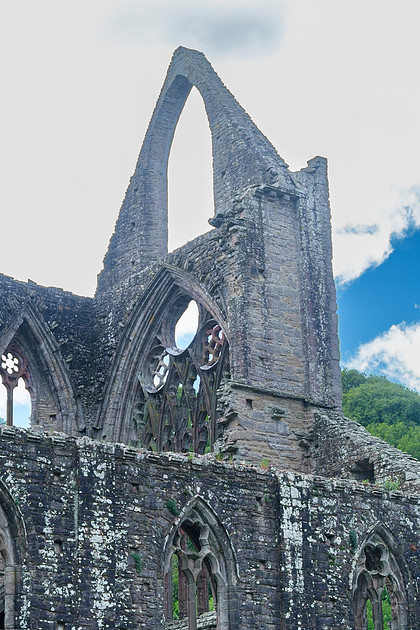
Tintern Abbey is among the most romantic and thought-provoking ruins that provides some inkling into the society that existed in this part of Wales almost nine hundred years ago. A monastic order somehow thrived in what was even then a backwater. Hundreds of monks and hangers-on lived a very hard existence while they fulfilled their harsh rules of life. But they also built what would be an impressive stone cathedral complex in a market town, much less on the edge of the forest. The large complex that we see today was started by the Cistercian monks in 1269.
Tintern Abbey was closed for business by Henry VIII, whose religious conversions were motivated more by an effort to grab the wealth of the existing religious establishment than a desire for a male heir. He dissolved all of the monasteries, and their wealth was absorbed by the Crown. While it was easy enough to just change administrations in urban England, isolated religious centers like Tintern Abbey instantly lost their reasons for being. In a matter of decades the buildings began to fall into ruin.
But their will “always be an England”, and very soon after Tintern Abbey became a ruin, local efforts began to ensure it’s preservation as a historical site even while it continued to fall apart. For several hundred years this haphazard effort ensured it’s survival, albeit as a romantic ruin without windows, a lot of the structure, and not a roof in sight. In fact, most other the Medieval stonework hides Victorian and even contemporary structural interventions that stabilized the ruin that we see today.
My images do not come close to doing the site justice. I realized within minutes that it would take an extended series of visits to really learn the ins-and outs of the site. Most of the “classic” shots required access to areas where ordinary visitors were not allowed.
In any case we enjoyed our trip to the Abbey, where in Faulkner’s words, “the Past is not even the Past.” Not a dragon or a knight in site, but we got closer to the Medieval world than anything Hollywood has to offer.
