ANOTHER LAURELHURST EXPERIMENT
ANOTHER LAURELHURST EXPERIMENT
APRIL 12, 2024
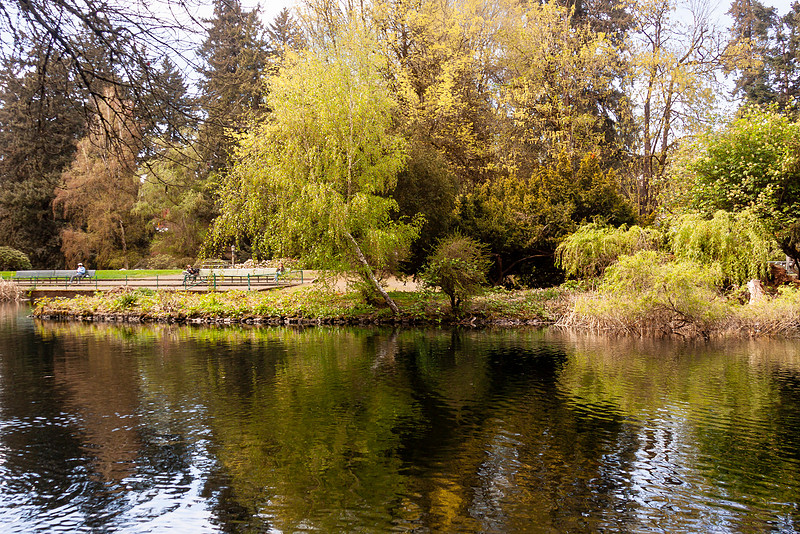

SPRINGTIME IN LAURELHURST PARK AT 1/60TH OF A SECOND
This week I returned to Laurelhurst Park for another round of experiments as I took out the tripod to increase my muscle memory so that i can increase my confidence in dealing with the recalcitrant "helper." It pays to do this once in awhile in order to check both your camera gear and your brain to see if anything has become rusty. Last week I was thwarted in taking any really long exposures since when I reached into my bag to take out my 10-stop filter I discovered that couldn't get the quite exquisite packaging open. Harumph!
I returned home and with the help of some pliers and elbow grease I released the filter from its case. So I returned today to try my hands at longer exposures. These three images will hopefully show you what you can achieve when you slow down your camera so much that a passerby might wonder what the hell you are doing. If you in fact slow it down enough then that person will not appear in the photo even if he walks right in front of your camera. These experiments can be fun but you must give up any hope of rushing anything.
Dealing with the tripod is absolutely necessary since we are taking exposures that last multiple seconds instead of fractions of a second that we are used to. No human being can hold a camera still even for "one Mississippi"; properly executed, with the right filters, a tripod can take a shot so long that you are tempted to bring a book along while you wait. A ten-stop filter blocks so much light from reaching your lens that you will only achieve a similar "correct" exposure if you increase your exposure times by ten stops or so. Each "stop" is letting in twice as much light, so you are compensating for the filter by increasing your exposure time by somewhere around 1000 times. The filter is so dark that once you put it on you can no longer see anything in your viewfinder - you must lock in your composition, determine a "correct" exposure, then put on the filter and blindly increase your exposure time the equivalent of 10 stops. Believe me, a ten second exposure seems just short of an eternity. Once the camera finally "clicks" you can then see what you have wrought, which does not look much like the reality around you. This is a real Goldilocks procedure, since you really do not know what you are going to get. It's just a matter of seeing what happened and speeding up or down a little and waiting another very long time again.
We are going to this trouble because we are trying to make images that reveal something beyond what is available to our own eyes at the scene. Just like a camera equipped with a strobe flash can "stop" a speeding bullet, with our tripod and filter we are slowing down time so that the scene appears differently than it does in real life. This in no way ensures a good image, but it can open our eyes to viewing a scene in a different way. This works exceeding well when we can combine stationary objects with parts of a scene that are moving in front of our camera. The moving objects are "smoothed out" because our exposures were long enough to miss the movement. This is the key to making waterfalls appear silky, or even removing ripples in a pond like the one at Laurelhurst.
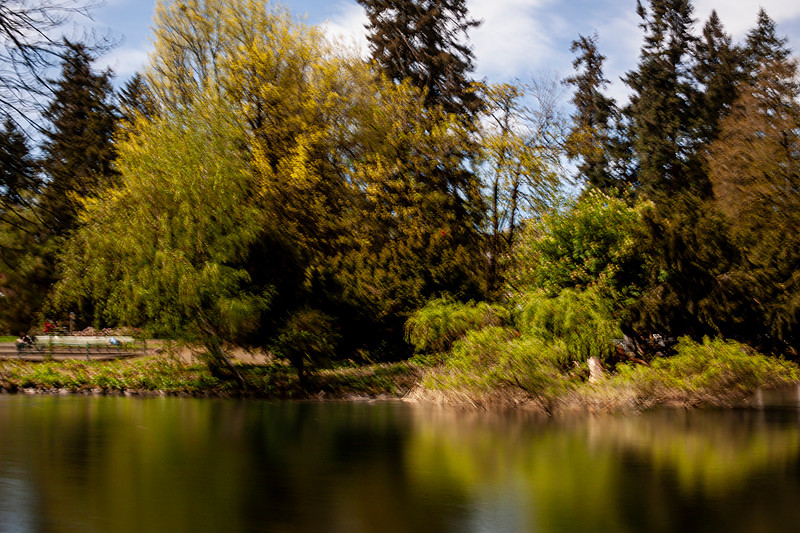
AT TEN SECONDS, WE'VE ENTERED OUR OWN REALITY
I've tried to explain all of this, but it might easier to just show you what happens. The first image was of a tranquil scene at Laurelhurst Pond. After some post-processing, I achieved a pleasant image that is sharp and properly exposed. Notice the sharp leaves and the ripples in the pond that some might say "ruin" the mirror image of the trees in the water. I might not agree, and you don't have to either. The first image was captured in 1/60th of a second, which of course a human being cannot really understand since it is much faster than we can snap our fingers. Think of the difference between Gold and Silver at the Olympics. The second image was taken with a ten-second exposure. After some more post-processing, the exposure is roughly the same, but the image is completely different, and the mood has certainly shifted. We don't quite know what we are looking at even though the tripod has not moved from the spot in front of my body. The water is completely still - it could be a sheet of glass. But the wind - there was no wind - has reduced the sharpness of the trees enough so that we seem to be looking at a dream of Laurelhurst Park instead of the reality in front of the camera.
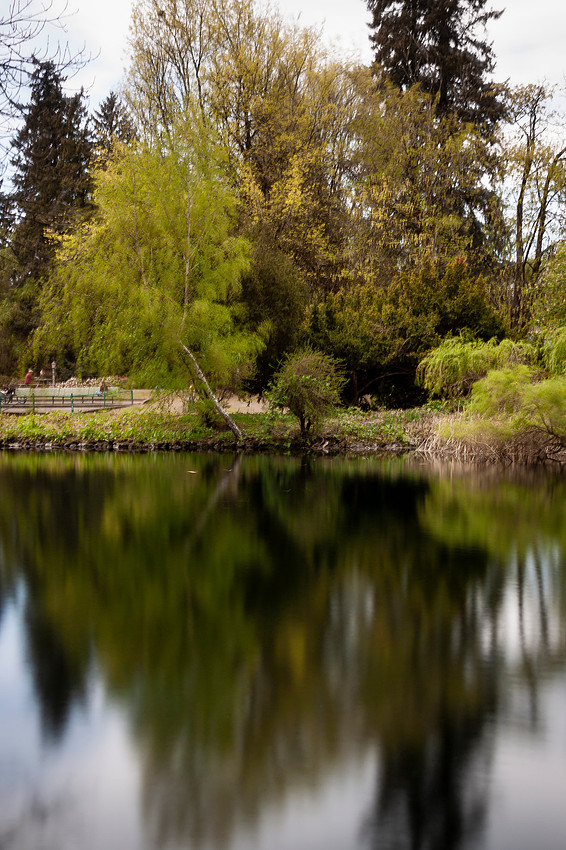 ANOTHER DREAM OF A FRIDAY IN THE PARK
Here is another example. This exposure lasted 15 seconds, but there was a little less of a breeze, so that the vegetation appears acceptably sharp. Yet the water and the mirror images are very different than what we expect to find when we look above the waterline. We seem to be painting a scene as opposed to capturing a snapshot. Once again we can see how far from reality the statement that "the camera doesn't lie" can be from the truth of the matter. Our images are our interpretation of the subject at hand, and some of the techniques we can use can remove our imagery from "reality" while revealing an inner truth that our mind saw even if our camera didn't. I encourage you to expand your horizons beyond what is plainly in front of your face.
