THE TURBINE ROOM, REVISITED
THE TURBINE ROOM, REVISITED
AUGUST 15, 2025
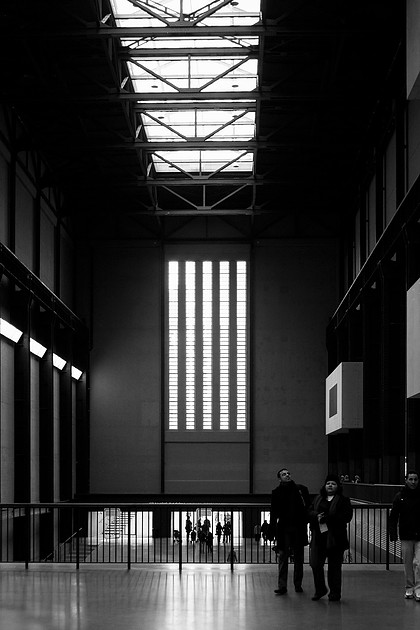

The turbine room at the converted Tate Gallery in London, seventeen years ago.
This week I would like to return to an image I captured about seventeen years ago while traveling with Fran and Benjamin to London. We visited the new (at least for me) "Tate Modern" Gallery on the South Bank of the Thames. This was a much heralded “adaptive reuse” project, in that a surplus coal-fired power plant on the neglected bank of the Thames, but directly opposite St. James Cathedral, had been converted into a gigantic new art museum. I’m old enough now that the Tate has since acquired yet another addition nearby and the South Bank has now become one of the “hottest” neighborhoods in London.
Before you congratulate me on my comprehensive photo archive that allows such ancient explorations, I would state that it is a near miracle that I maintain any records at all. I haven’t written any blog posts in a month due to yet another crisis in the management of my archive. I have become somewhat more responsible in the last few years, and when my latest and greatest external hard drive showed some signs of acting up, I leapt into action. In the past like most men I would have ignored the signs of impending doom and been left in a crisis when my primary hard drive met it’s maker. While I do have a full back-up system, it is still dangerous to let things get that far. So I hit the internet, and within one day a new hard drive was on my porch, immediately christened La Cie 6, which joined the legacy hard drives La Cie Prime, La Cie 1.La Cie 2 and the faltering La Cie 5 in my stable. We don’t talk about La Cie 3 and La
Cie 4, which lie broken and forgotten in a drawer in my study. They have not been destroyed due to the simple fact that several times in the past a “lost” hard drive has suddenly come back to life for no reason. This leads to a sudden emergency push to grab the data before it again disappears. If you think I have too much faith in one hard drive company, you might be right, except for the fact that my experience with other manufacturers has been even worse.
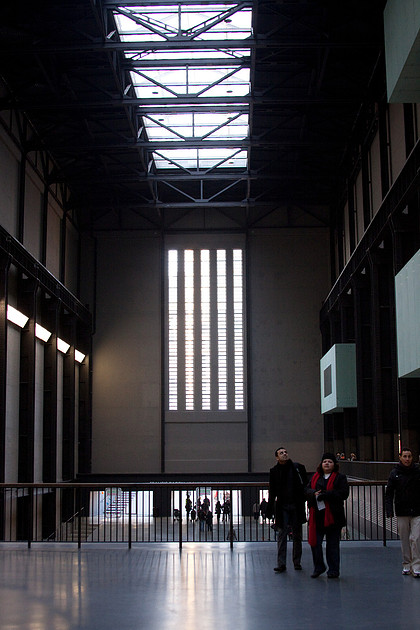
The original snapshot. What a nice red scarf amid the murky brown walls.
My story is not unique. When you have accumulated thousands of images over the years the only way to even come close to preserving them is to acquire multiple hard drives and try to create a system that will duplicate your data so that when a hard drive fails, and it certainly will, you have a simple solution of just buying a new one to take it’s place. I’m not even considered the least paranoid. I have friends who have hard drives in safe deposit boxes, friend’s houses, and pay hundred’s of dollars every year for online solutions which are problematic at best. I even have a friend who buys a new set of hard drives every January 1st, whether he needs a new one or not. The only thing that makes it a little less painful is that digital storage is one of the few things that gets cheaper every time you go to the store. The new hard drive was just as ridiculously large as the suspect one that I worried about, and thirty dollars cheaper. La Cie 6 is in fact eight times as big as La Cie 1, and costs only about 2/3 as much in inflated 2025 dollars.
So I congratulated myself on my digital maturity and started to transfer data to the new hard drive. This is a boring but simple procedure of “dragging and dropping” files from the older hard drive to the new one, hopefully before the older one gives up the ghost. The shear amount of data means that it will take some time, but it can happen in the background, and even over night, so it’s not a trial, until it stops working for no apparent reason. I spent over two weeks alternately cursing Apple, Adobe, and La Cie depending on my mood and the apparent cause of the problems, which of course kept changing. Yes, I did “shut it down!”, the classic solution for all computer problems, but that didn’t seem to help. Since each time I shut the computer down it required about twenty minutes for the terrabytes of data to renew on the hard drives only added to my pain. And of course, trips to “Help” for both La Cie, Adobe, and Apple were completely useless. La Cie tells you how to install the drive, which a child could do without any instructions - but doesn’t tell you anything about why it doesn’t work, because that is simply "unprecedented." Adobe blamed Apple, but offered no help. Apple was better. They acknowledge the potential problems, but their multiple solutions include instructions to follow screen shots that had nothing to do with the ones on the Mac I was trying to fix.
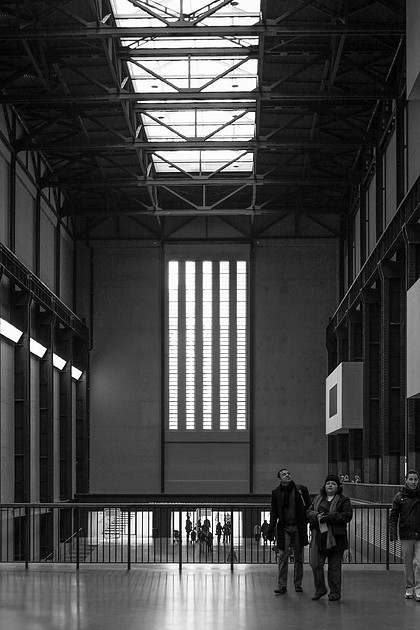
The initial black and white conversion. The computer revealed all of the details of the space and the people that I didn't give two whits about.
I
n the end I persevered, mostly due to some intrepid detective work based on grim experience and dumb luck. Even “asking The Google” which is Fran’s answer after “shut it down!” was no help. It turned out that “drag and drop” had worked like a charm, but that the Mac’s nefarious systems had decided to “uncheck" external hard drives from the devices that were listed on the finder. It’s hard to work with a new hard drive if you can’t find it. The the new hard drive refused to list the contents of the duplicated Lightroom data base. While this is theoretically impossible, since it was all there on the hard drive, I had to spend a week importing 15 years of the Lightroom data base that by all accounts should have already been there.
I wish I could say that everything was hunky-dory, but it’s good enough for government work now, and in the process I managed to eliminate thousands of duplicate files that were gumming up the works. I also found this image from so long ago. The original color shot was useless unless you had a thing for red scarves. The colors of the room and the people themselves were of no use to me. The Turbine Room became famous as an art exhibitio0n space because it could handle almost anything a curator could throw at it. The enormous area of the room, which had contained massive turbines to generate electricity for a good part of London, was impressive all by itself. Several rows of windows and massive skylights didn’t seem to alleviate the overwhelming gloom, which could only be relieved by lighting the art like actors on a stage.
The mystery of the Turbine Room is finally revealed by eliminating most of the superfluous details of the space.
I immediately turned to black and white since the colors were murky at best. The initial black and white conversion which followed standard procedures was completely lifeless. I was not interested in the actual perimeter of the space, so lifting the shadows to reveal details in the walls, floors and ceiling was exactly the opposite of what I was aiming at. In the end the final version concentrated on the light from the windows on the end wall, the skylights up top, and the reflections off the endless concrete floor. None of the highlight detail was lost, while the dark, dark mood of the space was absolutely preserved, at least for me. As was this image from the past, which lives on at least until the next hard drive disaster.
